Showing posts with label beauty. Show all posts

Wednesday, January 16, 2019

The early days of summer in Devon.

I've moved, many times, and although I'm drawn to the dynamism of city life, there's a part of me that yearns for life in the country. So after a few months in London, an escape to a farm in Devon sounded heavenly. I made arrangements with Becky, the owner of Cuckoo Down Farm, in February and in the middle of May, I found myself taking a train to Honiton (having left my licence in Ireland!) to spend a few days in the countryside - a welcome retreat from my busy life in the city.

It was a beautiful evening when, after a few wrong turns, the taxi pulled up to the farm. The farm is actually very well signposted and the owners were great at giving instruction by phone - shame neither myself nor the taxi driver were paying much attention, enrapt as we were with the winding lanes and pretty houses, barely visible through the trees.


A view of Cuckoo Down Farm, from the entrance
John, one of the owners, was straight out to meet me, and even took my backpack up to my safari tent, Daisy, for me (all the tents are named after plants). This gave me a chance to wander past the animals (goats, chickens, a donkey), over a wooden bridge and up the gently sloped field to the safari tent.

Inside, it was remarkable - like a country cottage - yet under a tent. Two separate bedrooms, furnished with high-quality beds and linen. The living and dining area was sizeable, easily enough for a couple of families to take over after a day at the beach or nearby attractions. A small kitchen had everything required - a proper kettle, gas cooker top, cutlery - and separate bins for food, recyclables and unrecycled waste. Cuckoo Down is intent on sustainability and friendly to the environment, so all guests are requested to bring their waste to the compost and rubbish bins at the bottom of the field where the tents and yurts are situated. Points from me! They'd also left a complimentary bottle of wine and warm wishes for my stay. This beats the luxury of 5 star hotels for me - it really feels like they care about their guests here.
Comfy sofa bed and part of dining table

After spending most of the day travelling, I was sweaty and tired, so I laid down on the sofa (bed) to restore my energy. A short while later, Becky arrived on horseback to say hello and check that I was settling in nicely. She let me know about some of the local area and pointed out the helpful book they have put together with details of local pubs, restaurants, culture and places to see. It is packed with things to do - you could easily spend two weeks here. Cuckoo Down Farm is only 12 miles from Exeter, and about 5 miles from the nearest town, but there are many things to do within driving distance, so it's highly recommended you bring your car. I got by fine on foot and public transport, but I never got to the beach due to no car - even though it was blisteringly hot. I considered hitching, but since it was mid-week, I thought I was unlikely to find a car headed that way.

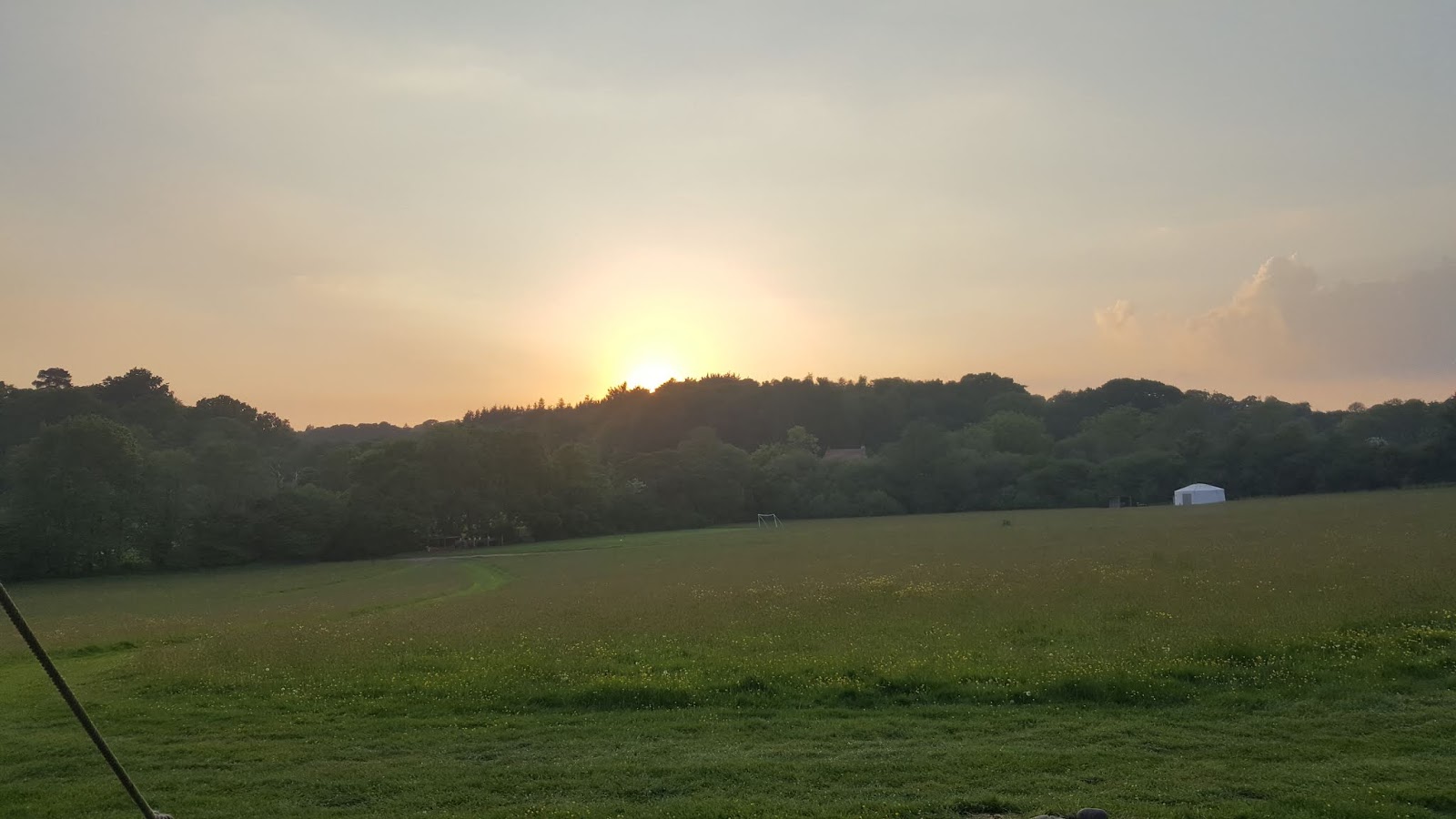
After discovering the local shop (reasonably well-stocked, but pricey) and wandering around the farm a bit, I sat down and simply watched the sun set from the deck.

It was utterly peaceful, with the only sound being the sheep in surrounding fields and birds singing in the treetops.

When darkness falls, there are lanterns to light the way to the compost toilet (right beside your safari tent) or for reading out on the deck. These can be charged back up at the entrance to the farm, and there are spares awaiting (there's also room to charge your phones/iPads), fridges for each tent/yurt so you can store chilled goods.

Next morning, gentle sounds of wildlife drifted into my tent and after a wonderful night sleep, I emerged in the dewy mist to wander through the woods at the back of tent. The scent of honeysuckle hangs in the air here and a few lungfuls will make you expel all the dirt of the city. There are a few trails through the woods that are easy enough for children, but be careful of ticks - I was fine, but I had my hiking boots and good socks on (even in the heat). I also ordered a dinner off Paul and Carolyn Bellinger, who have a small local farm, who are recommended on the Cuckoo Down Farm website. Proper, home cooked food that was steaming hot on arrival - the cottage pie was huge and hearty and the sticky toffee pudding was delightfully indulgent (and so far from the M&S or Sainsbury's packaged versions you get!) It's also very reasonable and delivered right to your tent, so if you're out on your feet, dinner is sorted.

I spent 4 days on the farm and it's been years since I felt so refreshed. I managed to explore both the local town, Ottery St. Mary and Exeter city, with the local bus that runs from a garage about 15 minutes away. Both were well worth a visit, with special mentions to The Rusty Pig,   where I had an exquisite meal cooked for me from just a brief conversation with the Chef, and the Glorious Art House; I stopped in for Wi-fi and found great food, friendly staff and a charming outdoor area hidden from passersby. On the other days I simply went for walks around the farm and nearby. In the evenings, I didn't feel compelled to go to the nearby pubs, simply sitting/lying outside with my book (and a cheeky glass of wine) was enough for me. For someone who is always on the go, this place gently put a stop to that. I would happily spend 4 days every week here.

For my first foray into the countryside of Devon, I was probably a bit spoilt! The chickens ran to greet me every morning (I must have smelled like food) and the sun shone almost every moment. Only on the last day the temperature dropped and I set up the wood-burning stove, which made the place lovely and cosy - perfect for a rainy day playing board games (or in my case, more reading).

Chicken Run!

Morning strolls
Plant life

Spacious, private, deck

Pretty Exeter


Better than most boutique hotels!


Monday, April 25, 2016

Part 11:Pub-crawling around the World - The Valley House, Achill, Ireland.

Far from just a bar, The Valley House in Achill is steeped in history, a previous Daniel Craig movie set and a top rated Lonely Planet hostel. I've mentioned it in many blog entries but never under pubcrawling. Now I'm correcting this clear oversight. It's difficult to pinpoint one particular night in this incredible venue as I've spent so many there but here are memories and reasons you should visit.
Slievemore at sunset, can be seen from the end of the lane at the Valley House

The location - Firstly, it's on Achill island, which is beautiful anytime of year but particularly in the summer months. The bar itself is hidden by trees, surrounded by a pitch and putt course and a small lake. It's less than a fifteen minute walk to the nearest immaculate and often deserted beach. It's courtyard captures stunning sun in the late afternoon and it's wonderful to while away a few hours basking in the sun there. I remember a particular bank holiday Monday in June 2007, guitars were out as was the sun, tunes aplenty and good company - it made for a perfect evening. Of the friends I spent it with, three live in different countries now, one is married with a child and one I have long since lost contact with.

The music. I can't remember many nights without music in this place, for me it's the first place I think of when I hear "session". From regulars who show up with their guitar to visiting musicians with banjo's, flutes, violins or crystal-clear voices - I have never heard such a diverse amount of talent in any other venue, and here you don't even pay for it. Even the owner, Pat and his wife, Alice, are great musicians and the "sesh" is encouraged every night. There are people who have been joining in the sessions here for over 30 years (including my own Dad) when Pat's father, Roger (RIP) ran the place. If you want a bar with music in Ireland, you can't go wrong here. My own favourite memories centre around jamming with my Dad when we've been here together, particularly August bank holiday 2012 and 2013. Hearing an ensemble version of "The Weight" with impeccable harmonies still resounds from 2008 and a version of "There is a Light that will never go out," will always remind me of nights in the Valley House.
Regulars taking part in the "sesh" one summer night

An inexpensive bed can be stumbling distance from the bar. In the cooler months of the year (of which there are many in Ireland), it is nice to stay in the warm confines of the Valley House after a few pints of Guinness (or whatever you're having). It is advisable to book ahead for holiday weekends - i.e St Patricks Day, Easter, Hallowe'en etc. The Hallowe'en party is normally great craic. Music as always and an array of creative costumes, from Slash (Guns N'Roses) to a French courtesan (portrayed by a man), Robin Hood to Sponge-Bob. It's great to be able to crawl up the stairs and not out into the freezing night, particularly in October or March - or even sometimes May!

The Guinness must be mentioned. It was the bank holiday weekend in October 2006 and a group of us were staying in the Valley House, sharing the 12-bed dorm (great fun, as you can imagine). Åine , a friend, was buying a round for everyone and was insisting that her friend's boyfriend, John, didn't need another pint of Guinness. I had been on the vodka most of the day and actually had a pain from it. John and Åine went back and forth over this and eventually she included him in the round. At this point, John looked over at me and said "You have to drink this pint, I can't." That was my first Guinness. After a sip, it eased the pain I had in my tummy and I wondered why I hadn't been drinking it all weekend! Since I have travelled to many countries, drank Guinness in a number of Irish bars and around Ireland but I haven't found anywhere with a pint like the Valley. In the final stages of the drive from Dublin, I salivate at the thought of the pint that will soon follow.


Ambience: 10/10
Cost: $$ (I haven't been in awhile but by memory a pint of Guinness is around EUR4.40, you must try one!)
Food: Now renowned around the county for it's stonebaked pizza, sometimes other food is offered. Always good quality pub grub and great after a day at the beach or a few hours whiled away in the pub. Reasonably priced.
Location: You will need a car to get here. It's located in Dugort on Achill Island and public transport isn't very accessible. There are some taxis on the island.
Toilets: Well maintained and cool on nights where the bar gets very warm.
Overall: If you don't visit here you're missing a genuine hidden gem and my favourite bar in the whole world.


Their own website has more photos, details of upcoming events and information.
/http://www.valley-house.com/

Sunday, February 14, 2016

5 places worth a visit on your travels

To me, everywhere is worth visiting once. I have found enjoyment in every place I've been and just because there are places that I won't rush back to doesn't mean that I regret visiting there in the first place. Then there are these places, which are truly special. They might be a little trickier to get to, or you may not have them on your list for a variety of reasons (distance from other places, budget, transport options etc) but I highly recommend (read: suggest you visit or you are missing out!). I either have gone back already, will go back or a little part of my soul will pine for them.

1. Achill Island, Co. Mayo, Ireland. I have raved in previous blog entries about Achill, my favourite place in the whole world. Why should you put Achill on your list? Its scenery will take your breath away, from the craggy  rock formations, many pristine beaches perfect for surfing, kite-surfing or just a swim, magnificent cliffs rising into modest mountains that are well worth a hike, delicious seafood and Irish music sessions in many pubs waiting to serve creamy pints of Guinness. I can't extol the virtues of this island enough. From the Atlantic Drive to Keem Bay, barbecues under the shadow of Slievemore at sunset, a good walk to knock out the cobwebs on Keel beach and settling in at the Valley House for a pint and great tunes - it's hard to beat and I'm sure you'll agree.
Slievemore at sunset

The writers Graham Greene and Heinrich Boll spent time living on the island and many an artist has taken up residence there.

How to get there: Train from Dublin to Castlebar, then 1 hour bumpy bus journey to Achill Sound, or hitch - plenty of friendly locals and travellers pick up on the road from Castlebar to Achill.


2. Trakai, Lithuania. Never heard of it? Probably not but it's fantastic. Only a stone's throw from the capital of Vilnius, which is also worth a visit, Trakai is definitely budget-friendly and worth a visit for it's Gothic castle (with unique architecture for Eastern Europe), the bridge, the maze (yes, a maze you can get lost or found in!), a range of outdoor activities - including sailing and rowing and the fact that it's a national park. It's been quite a few years since I visited (hint: I was a teenager at the time) but it still pops up in my dreams. Grab some local food for a picnic beside the lake. If you wish to do more than a day trip you can get apartments for less than EUR40 a night.
Image from TraveloLithuania.com


How to get there: From Vilnius, there are regular buses every 20 mins or so. There are also trains for the short journey.


3. Koh Chang, Trat Province, Thailand.
Koh Chang is definitely growing in popularity but it's still much cheaper than most of the Thai islands, such as Koh Samui or Phuket. Don't expect the karst formations that you'll find on the Andaman islands, but there are plenty of picture perfect beaches here with far less crowds than the famous spots on other islands. It's pretty hilly and is great to explore (be careful of the wildlife in the jungle) and you can also hop onto other, even less visited islands from there. If you really want the 'backpacker' feel you can stay at Lonely Beach, where the nightlife is anything but lonely. Massages start at around EUR5, accommodation can be as cheap as EUR8 per person sharing (even in a double room) and a wide range of cuisine can be found on the island. I recommend Kai Bae beach, for location and the beach.

Me, a swing, Kai Bae beach.
How to get there: We got burned on our trip because the internet doesn't always tell the truth! Well, information changes, I guess. If you are coming from Bangkok, it is recommended to get to the Ekkamai bus station EARLY (and/or book in advance) and get a bus that leaves before noon. It takes about 4 and a half hours to Trat. Some buses go directly to the pier where boats leave from, others just to Trat and you have to share songtheaws (they resemble pick-up trucks with benches in the back) to the port. The last boat to the island leaves at 7pm. The boat takes about 30 minutes to cross and then you will have to pay about 150bht to get to whichever resort you're staying in.

There are also buses from near Victory Monument in Bangkok to Trat and Koh Chang, they leave hourly but once again, be aware that due to demand there may only be 2 or 3 buses running rather than hourly.

http://iamkohchang.com is a good website if you're planning to travel there.

4. Tarife, Southern Spain. Forget Gibraltor (seriously, it's not a nice place) and go a bit further down the road to the charming town of Tarife, which is also the southernmost tip of Spain. Although it barely gets a mention in guidebooks and isn't the prettiest of port towns, it is a haven for kite surfers and also offers pristine white beaches both on the Mediterranean and Atlantic Oceans (the two meet here) and there are wonderful views across to Morocco. There's the Moorish Castillo de Guzman el bueno fort to visit and the Church of San Mateo plus plenty of lovely tapas places to eat for under EUR10. It is definitely worth a weekend trip if you're interested in geography or history.
Med on the left, Atlantic on the right

How to get there: The nearest airport is Gibraltor, but Malaga is only an 1 1/2 hours away so you can see more of the Costa del Sol before taking in Tarife or plan your trip from there.  The easiest thing is to hire a car (pretty inexpensive - from EUR45 per week) but you can get a bus from Malaga. There are also regular buses from Gibraltor and Algeciras.


5. Kaikoura, South island, New Zealand. Last, but by no means least. There are so many places to get to in New Zealand but I've noticed that this one is sometimes missed. I have no idea why. Kaikoura is known primarily for year round whale watching, and it's absolutely worth it. Although I missed the money shot (the tail raised out of the water) I did so because watching it took my breath away. There are also large seal colonies in the area, fantastic to watch, even from a bus and dusky dolphins out at sea. Even though I visited in peak season, the small town wasn't very busy, which is nice for a break when travelling. You can see a longer post I wrote on a local bar/eatery here.
Sunset on the beach


How to get there: There are regular buses from Picton, which take around 2 and a half hours, whilst buses from Christchurch take only slightly longer and fares are very reasonable (you can get buses from NZD$1 in Christchurch, whilst it's around NZD$15 from Picton).

Kaikoura is not a cheap destination, although if you're already in New Zealand you're probably aware. Still, if you're on a backpacking budget it's probably a good idea to set a little extra aside for the even the basics here.
The walkway at 7am, beautiful mountains in the distance.
Realistically, I could put so many places on this list but these were the ones that I see mentioned least online, that were special to me at the time and still remain in my mind. Where are your places? I'd love to hear so I can add them to my list.

Wednesday, January 28, 2015

Rotorua - Not just a place with an unusual odour ....


Yes, when stepping off the bus in Rotorua, the first thing you will notice is the sulphuric scent on the air. It's a little startling at first and although you won't quite get used to it (well, certainly not in a day - the length I spent there), it's not terribly unpleasant. It's unusual, but the geothermal hotbed that causes the smell is definitely something to explore.

Rotorua is classed as a city, but I would call it a town. I found it rather quaint, set beside the lake of the same name with low-rise buildings. We were dropped off outside the local iSite, NZ tourist offices. The staff were super helpful and stored my backpack for the day for a small fee (It closes at 7pm though and my bus was at 11.15pm). After getting some info, I headed out to Te Puia, a Maori Cultural Park not far from town. I managed to get a bus just around the corner from the iSite and I was at the centre in less than twenty minutes.

Once more, the friendliness of the Kiwi people was displayed by the woman selling tickets. She asked me lots of questions about travelling solo as a woman and she said I was very brave. Then, she gave me half price tickets to the Maori concert which takes place a couple of times daily!

I decided to have a wander around myself first before taking a guided tour. One of the most important things about Te Puia is that it's a place of learning and preservation. Customs of the Maori tribe are in use and taught to Maori students from tribes across New Zealand from weaving to stone carving. Thus, all the carvings onsite are truly Maori and faithful to time-honoured tradition.

During the first part of the tour we were brought up to see the famous Pohutu geyser. This was truly a sight to behold: going off approximately every hour and lasting for upto twenty minutes, this is the largest active geyser in the Southern Hemisphere and it certainly gets your attention. I was mesmerised by it. A natural wonder of the world. The photograph doesn't do justice to how it dwarfs you and the heat can be felt from 10 metres away!

There's quite a lot of geothermal activity here, covering 60 hectares, with over 500 geothermal spots. Even on a cold day, I can't imagine you'd feel it here; there's steam rising from everywhere!

After an hour or so of exploring the geothermal landscape and marvelling at hot springs (that are far too hot to bathe in), we returned to Te aronui a rua, the meeting house where the concert would take place.

A woman came out to greet us, with the typical "Kia Ora!" and advised us on the etiquette of the show we were about to witness and be a part of. A man in the audience was chosen as chief, and we all approached the house behind him, as is customary.

They took us through songs and stories, displaying dances and the infamous haka (with some volunteers from the audience!). Some of the strapping young Maori men weren't hard on the eye either! It was great show and well worth the price of the ticket. I'd be really interested in going to the night time show if I ever return.

The Haka

After visiting the word carving and weaving workshops, I took my last wander around the landscape part of the park and headed back into town. I was very lucky to be picked up by French and German girls who had a car rented for the day and who I'd spoken briefly to at Te Puia.

I grabbed some fish and chips for NZ$12 at a quiet cafe on the main street, about two blocks from the iSite, although I can't remember it's name. It was also conveniently close to my next port of call, The Polynesian Spa. I got an unlimited pass for the Adult Pools for NZ$25 and headed in to bathe myself softer than a furry blanket. It's truly blissful in there with a variety of pools to choose from and temperatures ranging from 37 deg Celsius right upto 42 deg. I didn't stay in that one too long!

The Priest Pools, with the lake in the background
My favourite pool was the Priest Spa pool right by the lake, so birds were flying by and providing a chorus as the sun went down. It was a real treat to bathe in the hot spring waters and wonderful to ease the muscles after a few bus rides.

After touring the seven pools a few times, I decided to grab a snack and head upto the iSite to wait for my bus. Rotorua is absolutely deserted at night so there was nowhere to wait and I didn't see a bar nearby where I could have chilled for an hour before the overnight bus to Wellington arrived. Thus I was a very weary traveller boarding for my long journey (8 hours) to my next stop.


Tuesday, October 7, 2014

Part 8 - Pub-crawling around the World - Wijaya, Thalpe Beach, Sri Lanka

I stayed in Hikkaduwa for most of the time in Sri Lanka, Volunteering for Manacare, but I definitely had a few social nights out, with a great group of girls who took me under their wing for the duration. Although Wijaya wasn't my most unique Sri Lankan experience, it was definitely the bar in which I spent the most time, and it's suitably off the tourist beaten track enough to warrant comment and recommend that people go there.

Wijaya is a stone's throw from Galle, in Dalawella, Unawatuna - a very short drive from the cluster of busy beach bars in Unawatuna. It's on the main (Matara) road, or can be entered from the beachside. My first afternoon spent there was a Poya Day so I couldn't partake in any alcoholic beverages, I really enjoyed the virgin fruit cocktails (mango...mmmmm) and their wood-fired oven-baked pizza's were definitely tantalising after the steady diet of "rice and curry" I'd been living on.


I was lucky that I was in the expat scene, by virtue of my friends living there, and it's a very popular spot for people that live there to hang out, whether by day or night. It's proximity to the beach (most people actually have a swim and then a bite for lunch/dinner in Wijaya) makes the views simply spectacular, and it's not spoilt by pounding music or loads of holiday makers trashing the beach. In fact, the beach is clean and you'll see many local people swimming in the sea here. Depending on the time of year and the tide, you may be lucky enough to experience the little whirlpools that form in small reefs along the beach, leading to a jacuzzi-like experience! (My camera wasn't waterproof, unfortunately - but I can still remember the sensation).
copyrighted image


If you just want to lie in the sunloungers/deck chairs make sure you get there early, particularly in season and at the weekend and you may just be lucky.

I visited a few times, and although you can definitely eat and drink in cheaper places (it's definitely not remotely expensive if you're holidaying from Europe/The Middle East/Oz or U.S.A) I don't think that you'll find anywhere as clean, with such great cocktails and food and it's definitely affordable on a backpacker budget. The pizzas are pretty renowned but I also ate prawn salad and some more Sri Lankan offerings and everything was fresh, delicious and with generous portions. The cocktails were yummy too, evidence of the amount of fresh fruit on offer.

Sarah, CJ and myself with yummy cocktails

Of course, as with any beach bar in Sri Lanka, if you're going any time past four pm, ensure you are sensibly lathered in citronella or deet as the mossies also like Wijaya, and I woke up with approximately 30 bites on my leg one morning! They must have smelt the sweet cocktails...

Although I didn't stay here, I believe Wijaya also has some boutique style guest rooms, which are romantic, clean and budget-friendly (also creepy-crawly free, according to people who have stayed there). If you need something more private and a little bigger - my friends have a beautiful place right across the road - with an open air shower and chipmunks playing in the trees. 


Ambience: 10/10 - I can't fault this place, from lounging and lunch, beach and beer or a cocktail night with friends, it's chilled but you can still party here.
Price: Rs. 400 alcoholic beverages start very reasonably but steadily rise.... cocktails are from Rs. 750 upwards. You can bring your own wine, corkage is approx. Rs. 1000 (which is quite reasonable). 
Food: The food here is a highlight, Pizza's around Rs. 1200, My prawn salad Rs. 850, and there were plenty of prawns. Yes, It's on the high side but the portions are healthy and the food is tasty and fresh.
Location: Matara Road (you can get a bus to stop outside! I used to get a Matara bus from Hikka or Galle), Dalawella, Unawatuna. From Unawatuna, expect to pay about Rs.400 upwards for a tuk.
Toilets: Very clean and there are outdoor showers to wash the sand from the beach off :D
Overall: I spent quite a few nights here, met so many expats, locals and holiday-makers. I really liked the place and I hope to visit again.

Their own website can be found here www.wijayabeach.com

Wednesday, September 3, 2014

Day trip to Rotto (Rottnest Island)

Whilst in WA, I noticed how the Aussies like to shorten everything and often add 'o' to place names rather than say the last four of five letters, which has much in common with Dublin slang (Dubs like to use it particularly for men's names - Damo, Robbo etc). However, when people were referring to Rotto, I didn't realise they were talking about Rottnest for awhile, even though it was top of my list of things to do whilst in Perth.

So, one beautiful summers' day in January I took the Rottnest express from Freo (Fremantle) Shed B across to the island. It's a roughly 40 minute trip and if you're prone to sea-sickness bring a bag!  It's a choppy enough ride across but I managed to keep it together. I paid approx $40 return and I'd advise getting the boat about 8.30 to make a good day of it.

Rottnest has a somewhat chequered history, despite it's unfettered beauty - its' bays and rocky outcrops are final resting places for many a shipwreck and her sailors. It also housed  German and Austrian prisoners during the WW1 but exclusively Italian enemies during the Second World War and conditions were said to be tough on the island, being as it is so exposed to the elements. It was a look-out point in the Indian Ocean for the Allies. Since, it has become a favoured holiday destination for Aussies and other tourists alike, which is unsurprising given that it has over 60 beaches and 20 secluded bays in it's small 11km landmass. It is a haven for watersports lovers with different beaches being suitable for snorkelling, surfing or watching whales, dolphins, fur seals and the varied bird life of the island.
One of the reefs off the coast of Rottnest, near Porpoise Bay
It is also home to an elusive marsupial, the Quokka, an animal usually about 11/12 inches tall. The island gets its' name from this animal, as when Dutch sailors landed there, they thought these animals were large rats (their tails are similar) and called it Rott Nest - rat's nest. This is what I went in search of.  Not natural predators, they have died out in many places and are virtually non-existent outside Western Australia. It is actually a crime to remove these creatures from Rottnest but I just wanted to have a look.

When I got there I chose to rent a bike ($21) and also purchased an all day Island Explorer (bus) ticket as it was almost 40C and I wasn't sure how long I'd ride under the hot sun. No cars are allowed on the island and although it was the height of summer and busy with tourists, once I left the main settlement area of Thompson Bay there were times when I was alone on the road with just the ocean to my left and various scrub and patches of woodland to my right. A faint breeze whistled in my ears and it felt like I was hundreds of miles from any city, not less than 20km off the coast of Perth.

I stopped at most of the beaches and secluded coastal spots on the South side of the island, and the only one that seemed to be packed was Salmon Bay - I arrived just as the bus did, expelling at least 25 beach-goers of all ages with hats, deck chairs, beachballs and picnics. It's obviously a safe and popular swim spot. I moved on and found some quieter spots to take in the view and snapped a few shots - every photo of this place is picturesque, no matter how basic your camera.

After about 80 minutes I decided to lock the bike up at a bus-stop (you can leave the bikes at bus-stops and hop on the bus, which is very handy) and I boarded the bus to see the rest of the island. The Island Explorer runs on a very regular timetable (every half hour if I remember correctly) and if you're there for only a day you can easily spend some time at 4 or 5 different spots across the island.

After passing some salt lakes but without spying any of the deadly snakes, dugites - part of the brown snake family, and sometimes known to be on the roads of the island, I got back to Thompson Bay and decided to walk to Bathurst Lighthouse nearby. On my way, I was lucky enough to meet some quokka's. 

The first one cocked his head quizzically as I approached and then continued eating whatever he had in his paws (?). I moved a little closer but I didn't want to scare him as I had heard they are very shy. He didn't move so I took a few photos but they didn't come out very well as the light was shaded by the trees and hedging.

I moved further down the road and one seemed to move out of the trees towards me, I had heard that they forage for food and sometimes try to scavenge off strangers, although you're not supposed to give them food. I stayed still and then he stopped, also looking at me. They have kind little faces, almost like a squirrel. When I tried to take a photo he ran off, the evidence is below.


Delighted at having met the inhabitants, I continued on the Bathurst and also took a swim at the Basin, another popular spot for bathers. I found the undercurrent quite strong here and I think you'd need to be a strong swimmer to brave the currents here. I found myself a good few metres from where I started, but the water was so refreshing and there was plenty of sea-life around.


Afterwards I headed back to the settlement and had some lunch at the Rottnest Bakery (really tasty but very expensive, fries alone were $7, if you can, bring supplies). There is a well-stocked local store, obviously for the holiday makers who stay in the cabins and on the camp-site, it also offers souvenirs but again, it is fairly over-priced. This is probably unsurprising, given that it has a captive market. There are a couple of restaurants and even a Subway, even you can't be away from commercialised consumer fare for too long.

I also had some time to explore the local museum, which gives more information on the flora, fauna and wildlife of the island along with some personal histories of various residents. Not many people actually live on the island anymore, preferring to commute for work from the mainland. 

My last stop before heading back to get the last boat (it leaves at 16.15, a bit early for my liking - I would love to have seen dusk here) was the church. A tiny little room, with a few wooden pews for worship, it probably holds less than 50 people, but how many more would it need to? There were some lovely plaques inside, commemorating past residents and loved ones.
Sweet memories.

I left the lovely island after my day there and vowed to come back - although it's a killer to get to from most places! It's a really unique and tranquil place and definitely worth spending a few days on.

(If you want to stay on the island, apart from the cabins and camping - there is the Rottnest Hotel and also the hostel - in the old prison lodgings!)

All photos are my own and cannot be used again without my permission.


Saturday, July 26, 2014

A chilled afternoon at the Chinese Garden of Friendship in Sydney


I spent seven crazy days in Sydney and there's so much I could post about - which I will eventually, but I first wanted to jot down my memories of a very calm afternoon spent in the Chinese Garden of Friendship, which is located in Darling Harbour in Sydney.

I had a Sydney card which, for approx AUD$150 allowed me entry to six attractions around the city but it was only AUD$6 for entry to the garden, which is a bargain by any standards in rip-off Australia (Sorry but the whole country is crazy expensive, no matter what currency you compare it to). Darling Harbour was jam-packed on this Sunday afternoon, people milling around eating ice-cream, shrieks from children playing nearby and some lovely tuneful jazz coming from street buskers nearby. I ducked into the Garden and I was immediately calmed by it's atmosphere and serenity, surprising given the scene I had just come from.

The Gardens are modelled on traditional Chinese gardens and symbolize the bond between Australia and China. The were opened in 1988 during the Sydney bicentennial celebrations and it's a popular venue for weddings and wedding photography due to the abundance of plant life and water features. There are guided tours but I chose to just take the leaflet and go by myself, enjoying the solitude and admiring the traditional Chinese art work and artefacts as well as the garden itself.


Throughout the garden you see all five elements reflected and used - wood, fire, earth, water and metal. There are also representations of the Yin-Yang symbols and the garden itself is based around these principles obviously perfecting the balance of the garden.

I particularly liked the three Ying Rock sculptures in the Penjing courtyard. Apparently this is a rare rock, and the sculptures are quite impressive. They are also surrounded by miniature landscapes and bonsai trees (Penjing is an art form of creating miniature landscapes, so it's suitably named!).


There's also a place to try on Imperial costumes: ornate designed gowns from the Ming Dynasty, and have photos taken (so children will be entertained) and Chinese tea and dumplings are served in the teahouse so you could genuinely spend hours here. I even spotted some (not-so-friendly) wildlife!

It's not a place I would have really considered visiting, particularly whilst in Sydney but now it's on my highly recommended list (along with the aquarium). Whether just ducking into the shade, out of busy city-life or to genuinely explore the ideas and philosophy, it's a wonderful place to while away some time and it was a really different, beautiful experience for me.


Wednesday, May 28, 2014

Sri Pada - The ascent of Adam's Peak

I had many plans for my month in Sri Lanka but my serious ambition was to climb Adam's Peak in the Ratnapura area of Sri Lanka. A religious pilgrimage undertaken by many Buddhists, it's is famous for the huge footprint (the "Sri Pada" - Buddha's Footprint) at the top, the climb is done at night, ascending thousands of steps. Curiously, it is claimed by Christians' and Muslims' as Adam's footprint, and in the Hindu tradition it is honored as the footprint of Shiva. My intention to climb it wasn't based in religion but more personal achievement - Adam's Peak clocks in at a respectable 7, 359 ft above sea level, and although that's paltry by Kilimanjaro or Everest standards, it would be the highest climb I'd ever completed and many describe it as pretty tough, even for experienced hikers. It is a hike, rather than an actual climb - I'm not sure if you could climb it, given that it is conical, but apparently there are 6 different trails up.
Sri Pada, looming over Dalhousie

I had limited time in which to do the hike, given the travel I had to do to get there. Although, Hatton (the nearest town to Adam's Peak) doesn't look that far from Hikkaduwa on a map, I had already discovered that public transport in Sri Lanka doesn't always go where you want it to, even when you're on it. So, I took a 7am train from Hikka to Colombo, standing in 3rd class on a Saturday morning, much to the abject curiosity of the locals around me. Given that I had my backpack and very little sleep, I sprung for a first class carriage from Colombo to Hatton (for the princely sum of approximately 9 euro). First class is an air-conditioned carriage where you have an assigned seat, and they show films (often in Sinhala but sometimes in English). At certain stations, men come on with baskets of various treats. I couldn't definitively tell you what anything they sold actually was but I had some pickled fruit and something hot and spicy that may/may not have been fish. It may not have been the best decision before undertaking a pre-dawn hike but I took my chances.

When I arrived in Hatton, it was absolutely bucketing rain. I had been told to avoid overpriced tuk's and minibuses, that I would find a Hatton-Dalhousie bus in the town. I crossed the bridge with a tuk-tuk driver chasing me, calling new prices as I studiously ignored him. Once I stopped, named my price and he refused but continued to follow me. As I went to cross the road on the other side, a bus drove through a puddle and drenched me from head to toe. The tuk driver appeared before me, trying to wrestle my backpack off me and said "Ma'am, come, 900 rupees." It sounded like a reasonable deal, so I went with him. It turned out to be a great decision, he chatted about the local history on the hour's journey and stopped at sites of interest, including a two-hundred year old tiny Catholic church, a tea plantation and factory and some staggering view-points over the lakes. I tipped him well and he laughed, because I had bargained so hard, but he was definitely worth it.

It was freezing in Dalhousie, having left Hikkaduwa where days were around 30 C, it was an unpleasant shock. I checked in at Achinika Holiday Inn and ordered some food. Unsurprisingly, everyone was doing or had done the climb. I met an English man, German woman and Sri Lankan man (who had been in the U.K and U.S for years) travelling as a group, who were going to attempt the climb that night. As it was out of season, we were strongly advised to get a guide - the path is not lit in November and conditions were very damp, many things could happen. We decided that between us we would hire a guide to lead us, starting at 1.45am, and after tea and biscuits I retired to bed.
Steps, thousands of steps

I'd like to say the room was nice, but it wasn't. There was a leak outside my door, the floors were wet and there were no heaters so I slept with double layers on, under the single blanket they gave me, and my own sleeping bag. I knew I needed to sleep before the ascent and it was only 7.45pm so I popped a couple of Xanax and went off to sleep.

When the alarm went off at 1.30am I wasn't as disorientated as I thought I'd be. I made my way up to reception in utter darkness, squelching through muddy puddles. It was drizzling slightly and I hoped the steps wouldn't be too precarious. There wasn't much conversation as the six of us set off (the group from the night before plus the guide and his dog). Dalhousie is a tiny hamlet and the only purpose it seems to serve is a pit-stop for the pilgrimage to the mountain, all tin shacks and snack shops, with a handful of guesthouses.

It was a twenty minute walk to the beginning of the steps, and our German comrade had decided we weren't going quick enough for her. The guide gave her a spare torch and she strode off, but when we reached the base point the guide had to call out to her, as he could see her torchlight over to the far right - she had gone in the wrong direction! I was relieved we'd stayed with him and silently vowed that I was sticking to the guide like glue for the rest of the hike. Between her and her husband going forward and the Sri Lankan man dropping back, soon it was just the guide, the dog and myself. The guide warned to watch and listen for wild boar (awesome, and my biggest fear had been leeches, not being torn apart by a wild animal) and said that snakes were unlikely but not unheard of. All very reassuring when Sri Lanka has the highest death-rate from snakebite in the world! Still, I soldiered on. I wasn't finding the pacing that hard-going but it was quite monotonous in the pitch dark, the only sounds our shoes on the wet steps. I had heard stories of water gushing down the steps in November but we seemed to be lucky and the rain was holding off. I was regretting my many layers of clothing though as I was building up quite the sweat.

Around 5am, light began searching across the mountainous landscape, finding lakes in the shade of valleys and I realised how high up we were already. As my legs grew weary I asked the guide how much further and he said "Ten minutes more,". The steps became steeper, on such an incline that made it necessary to hold onto the railings provided and still he told me "Ten minutes." When I figured there really only could be ten minutes more, he told me "Maybe fifteen minutes, I promise, and then the top.". Realistically it was about twenty but I so happy to see the temple at the top I didn't care. I was surprised by how many people were waiting, particularly as very few had passed on the way. There were probably 25 people there, eating sandwiches and having flasks of hot tea. I didn't feel hungry but I noticed the cold immediately. It was absolutely bitter up there, like mid-winter in Siberia (well, so I imagine - maybe Ireland in one of the freezing periods that have become the norm of recent winters). I apped back up and gazed around in awe. The views were tremendous and the air was the freshest I'd ever felt, like my lungs were being cleansed with each breath. It would have been the wrong time to have a cigarette, although a few were puffing away.

 Then, dawn. The sky broke apart slowly, the sun filtering through the cracks, lighting us up in a perfect moment. I felt completely blessed and maybe that's the power of the place - the truly awe-inspiring beauty from that view, maybe that's what some people ascribe to their faith, or believe that their God makes possible. Who am I to say?

It was magic.


After a quick trot around the temple (where the footprint is almost hidden, even though it's so large) I had to make my way back down. I intended on having a quick shower and making the 9.20 bus to Hatton so I could get back to Hikkaduwa by bedtime.

I thought the way down would be a doddle. How wrong I was. It's steps, and having climbed all the way up and resting for a bit, my knees weren't at all happy to have to go down again. By ten minutes down, I was almost dragging my right leg along, an old ballet injury acting up after years. By thirty minutes down, leaning on the left leg was causing that knee to buckle. Now I was asking the guide "How many more steps?" and he was saying "Not much longer." Still lying. I was hot (the sun was well up in the sky now), a little injured and very bothered. Triona at her worst. When I got back to the hostel and discovered that my room had no power and cold water, well, let's say they didn't get a good review on booking.com. The guide, however, got his tip (and had to go back to find the others - our German friend had disappeared again) and I was finally rewarded with a big breakfast (omelette, fruit, salad, 4 slices of toast with butter and jam) but unfortunately no bus.

Suffice to say I did eventually get back to Hikka at 8.30pm that night, where I was greeted by a rat in the house. Sigh. From great heights....

Saturday, May 10, 2014

12 things I learnt about me, the world and travelling whilst backpacking

Every travel blogger has the list - the ten things you learnt on the trip, and on them are some great tips for other travellers but one thing remains true - you really won't know until you do it yourself. No guidebook covers your emotions during your time on the road, and no one else can tell you what you will feel. The idea that it would all fit into a neat list is a little laughable but it definitely makes it more accessible to readers, so in pondering on my own recent travels, here's my list. It's all personal

1. You can call it lonely, or you can call it free.
Many people who have travelled speak about bad times on the road, saying it's not all good, sometimes you get homesick, things go wrong, you're reminded that life goes on without you etc, etc -
The funny thing is, there was never a time that I felt homesick - maybe because I don't know where home is anymore but mostly because I was enjoying the absolute freedom. The one time I had a rough week (being reminded that life goes on for the rest of the world) I simply couldn't dwell on it. I was in Sydney at the time, the weather was absolutely beautiful (except one day of pissing rain) and there was so much to see, do, explore and enjoy that I quickly realised that although life goes on elsewhere - I'm out here living it and how cool is that?
(Do I look bothered in this pic??)

2. Big Bottles of water are the way forward.
Seriously, when you're on a budget in Oz and NZ, stock up on big bottles of water from the supermarket. You can get them for $1, the 500ml are approx $3 or more each time if you buy in a local shop, and if it's summer - you're gonna need a hell of a lot of water. So, if you are long term travelling, invest in a refillable bottle - preferably somewhere cheap. I had a sturdy water bottle that saw me through a few countries, I just always made sure it was empty when I got to customs in the airport. Yes, liquids have to be under 100ml - but they don't mind empty 500ml bottles! Seriously, it's such a small thing that you forget but if you're in Oz/NZ for a month or two, this will actually save those precious pennies.

3. The Kindle app really made my life better.
I'm a paperback/hardback book girl. Every trip I take, I've normally got at least two books and generally end up buying one at the airport. Backpacking, this wasn't going to be an option. I downloaded the Kindle app to my Samsung and it was great on so many occasions. When delayed at an airport but had free wifi, I downloaded new books, looked at free stuff, etc. When adjusting to a new timezone it was time to download some more or finish a new one. Queues anywhere became completely stress-free because I had time to catch up on reading - which wasn't happening when I was out experiencing everything else. I've finally come around to the idea that technology really can improve my life.

4. Being flexible makes everything easier
I'm normally a big planner, spreadsheets, lists etc. This fell away when I started travelling because there is no point. I stayed longer in some places, shorter in others, sat at tables with people I normally wouldn't dream of, shared food on buses with complete strangers and I also began to accept that no one, anywhere, runs to my schedule, and I kind of liked that. It taught me a valuable lesson in life - things really are only a problem if you make them a problem. It's plastered on all sorts of self-help and positivity sites but everything is really about your attitude. I also had to pay to change many flights, book other ones etc. So, my advice to anyone else is - get the MOST flexible RTW ticket you can, because anything you lock down is likely to change - and you can do without the $150-plus change fees, even if you don't care so much about them anymore. (When I got home, I realised that I may have been flexible but my credit card isn't so much!).

5. One nice dress is a must on the packing list.
I made a silly mistake when I went to Sri Lanka, assuming that because I was volunteering for a month in a charity that I wouldn't need anything too dressy. How wrong I was! After only two days there I was invited to an evening with international sports stars and the following night we went to watch an orchestra perform. I was really lucky that I had *just* met a great Aussie girl who happened to have a similar body type to me, and that is unusual. She lent me a dress for the first night and I winged it the second night but there were many times I felt underdressed. It's fine if you're just island-hopping but there may come a time that a nice outfit will come in handy.
Thanks CJ for the dress!


6. Make friends with people completely different to you.
I normally wouldn't dream of socialising with anyone much younger than me, being as I'm not really that young  anymore (sad to say!) however I struck up a wonderful friendship with an 18 year old German girl in New Zealand, and we really 'got' each other! Elsewhere, I had some brilliant nights out with two other girls who hadn't even started college yet and it all reminded me that age is just a number when you're travelling. I was never treated as 'older' and even when people were much older than me, I realised that we're all in the same boat, having these new, crazy experiences. I felt even freer around younger people to do crazy things as they absolutely don't judge (something that happens when you're stuck in a rut in Dubai or elsewhere). It lead to some absolutely crazy nights in Sydney and Queenstown and they are great memories. I did draw the line at having a dalliance with a particularly 'hot' 19 year old guy, but maybe I shouldn't have!!
Jessica, myself and Nicole at Wake Up! in Sydney - one of those crazy nights!

7. If you've been up one tall building, you've been up them all.
Of course there are a few cities where the tall building is a must - I'd probably say Kuala Lumpur, as it's the Petronas Towers, but funnily enough, I didn't get up that one. These usually cost a fortune, and EVERYTHING is extra - a bar of chocolate at the top is a total rip-off. I skipped it in a few places and I don't think I missed anything. I guess it's personal, but unless it's got free or half price drinks (The Marriott in Bangkok 5pm - 7pm, Ladies night champagne at the top of the Burj Khalifa in Dubai), skip it. Looking down on most cities is much the same as looking down on another and doubly skip it if the weather isn't great. I didn't climb Sydney Harbour Bridge as I thought the price was exorbitant, and I had just jumped out of a plane a week earlier for about $50 extra - not much is going to beat that.

8. How I didn't get sick travelling...
Well, my anti-malaria tabs made me throw up on the street in Bangkok (no, not a hangover) so I quit them, however I have managed quite a few countries without illness - Cambodia, Laos, Vietnam, Thailand, Malaysia and Sri Lanka included. How? A girl in Dubai gave me this wonderful tip, take a spoonful of the tap water every day in each place you get to, it builds up your immunity. I ate local foods, salads etc, I brushed my teeth in tap water, I generally ignored much advice, if I wanted to eat it, I did. I didn't get sick. Perhaps I'm just lucky or have a great immune system but honestly - before that I used to have a dodgy tummy quite regularly and that was whilst living in Dubai, so I'm sticking to her advice. I did, however, have great travel insurance - just in case.

9. Keep a change of underwear and top in your carry-on.
Amazing when you've been 16 hours in an airport, as I was, in Malaysia.

OK, now I'm thinking of loads....but I'll probably stick them in the blog as I go along anyway. So the last three -

10. Thai bank machines charge horrendous fees, try and have cash changed or USD on you to change before you go.
Pretty self-explanatory.

11. Always have a scarf/wrap etc whilst in Asia (or for that matter, the Middle East)(or anywhere with changeable weather)(and also the plane!)
It's first and foremost about respect. If you're wandering around on foot and you want to go to a temple, you may need to cover up. Some places insist on it. I had one scarf and I had this wonderful wrap around cardi which doubled as many things and also kept me warm on planes (budget airlines with no blankets!) many times. Seriously, my most used item. It was nippy in SE Asia over Christmas, surprisingly, and that wrap was worn almost every evening. Sssh, I moved around a lot, most people wouldn't have known!
That's a wrap!


12. Plan ahead with snacks.
6 hour bus journeys can turn into 12 hours, planes get delayed, Trains may not serve food, you may be on foot for longer than you think. In Oz and NZ you can purchase food on board but it will seriously cost you. I was so lucky in Auckland that my friend's mum had kindly left out things so I could make sandwiches - otherwise I would have forked out NZ$56 (!) for the lunch onboard. I learnt that lesson and it really stood to me in other places: once we stopped for food at a completely fly-infested place - seriously you couldn't see for the flies - and there was no way I was eating there. Thankfully I had brought ritz crackers (well, something like them!), a mandarin and a bar of chocolate. I have countless stories similar to this. Perhaps this is another reason I didn't end up sick.

I'm sure I'll update and add to this but most people have their own versions - about camera batteries, SD cards, laundry bags etc. These are ones I didn't find and that meant the most to me.